

Rest, relaxation, hardening, fitness, cleansing: no matter how old we are, sauna bathing has many positive effects on body and mind. More and more people are realizing this. Regular visits to a sauna have long since become a routine and an established part of our everyday lives. It makes no difference whether we relax and recharge our inner “batteries” in a public wellness and sauna area or in our own home sauna.
The more pleasant and comfortable the sauna climate, the easier it is for us to switch off, fully relax, and recharge.
This article aims to show how important the properties of wood and their effects are in sauna construction, why a sauna should actually be built primarily from wood, and which types of wood are especially popular for sauna construction.
Wood and its properties
Looking back at our historical timeline, it is clear that trees are among the oldest cultivated plants. Whether used as a construction material, in boatbuilding, mechanical engineering, furniture, windows, doors, stairs, or even entire houses, wood is an essential raw material that we encounter everywhere in our daily lives. It has many different properties:
Visual properties
Every wooden product is unique. There are not only many different types of wood, but even within a single type there are significant differences in structure and appearance. No two wooden boards look alike. The wide variety of shades and color nuances also makes wood a unique and popular raw material. This quality makes every sauna a visually appealing one of a kind.
Acoustic properties
Wood not only has sound-insulating properties − it also acts as a resonator. Depending on its density, elasticity, fiber length, moisture content, or various defects in the wood, the speed of sound can be affected. Body-conduction speakers installed outside a sauna use the wood as a resonator. This allows sound waves to spread optimally and evenly throughout the sauna interior.
Differences in density, hardness, and weight
Woods vary in density and hardness. Tropical woods, as well as birch, beech and European oak, can often be very hard and weather-resistant, while pine, spruce and alder are softer. Softwood is suitable for sauna construction because its hygroscopic properties mean it does not heat up as much. As a result, fewer cracks form and the wood does not warp.
Thermal properties
Wood types differ not only in their texture and appearance, but also in their thermal conductivity. Since wood is a good insulating material, its thermal conductivity is low, depending on the type of wood.
Not every type of wood is suitable, for example, for building a sauna bench, where we come into contact with the wood, naturally protected by our sauna towel. To prevent burns during sauna bathing, wood with lower thermal conductivity is specifically used for these parts of the sauna.
Why is a sauna always made of wood?
If you enjoy sauna bathing, you know that saunas are always built from wood. Why is that? Why aren’t saunas tiled? That would be much easier to clean.
Fifty years ago, people were content with a rather simple wooden box for sauna bathing, made almost entirely of plenty of wood. By today’s aesthetic standards, these “plank saunas,” where the only view was through a small peephole in the boarded wooden door, are no longer appealing. Today, the trend is more toward design saunas. Clean lines, fine woods and, above all, plenty of glass for an unobstructed view and a greater sense of openness.
However, to maintain a comfortable and gentle indoor climate, glass should be used in balanced proportion to wood:
- Wood has hygroscopic properties that create a pleasant indoor climate. The sauna heater warms the air. The wooden walls absorb heat and moisture to a certain extent; anything they cannot store is continuously released into the room. Glass, on the other hand, cannot absorb moisture and heats up quickly. Glass fronts therefore release heat into the room, making it unpleasantly hot in the immediate vicinity.
This means that the more wood is used, the more pleasant the heat feels during a sauna session. - Unlike plastics, wood is also dimensionally stable and heat-resistant, so it hardly warps even at high temperatures of 100–110 °C.
- Another important factor for a pleasant indoor climate, in addition to correctly positioned ventilation, is using suitable sauna wood. Certain types of wood have low thermal conductivity, so you won't get burned when you come into contact with sauna benches or backrests.
- Another factor that contributes to a cozy sauna atmosphere is the natural, aromatic scent released by some of the resins in the wood, which fills the entire sauna interior.
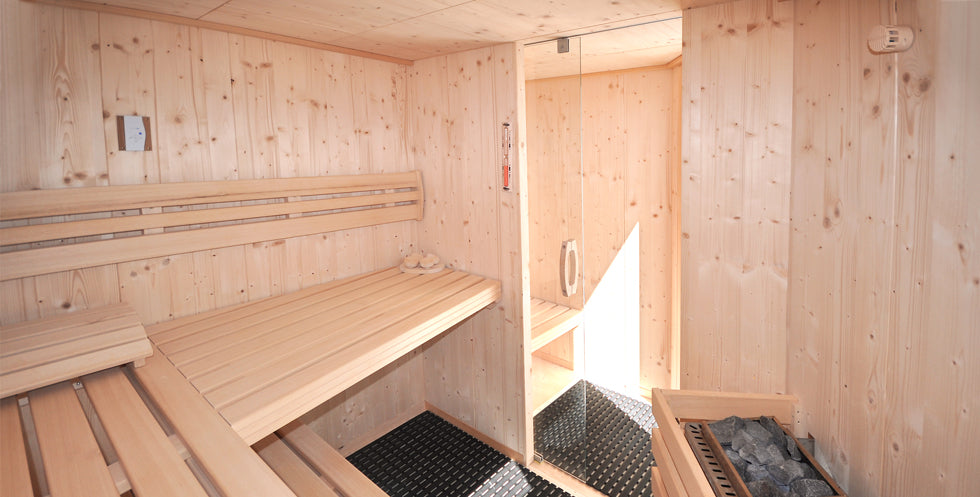
Which wood is suitable for sauna construction?
As mentioned, wood has different properties, and some types of wood are specifically suited to sauna construction. In general, high-quality wood should be used and should have the following properties:
- should be resistant to warping
- have relatively few knots
- not splinter
- not release resin
Since wood is exposed to extreme heat and high humidity, the following types of wood are particularly well suited to sauna construction:
Abachi
Thanks to its low thermal conductivity, abachi wood is indispensable in sauna construction. It is ideal for surfaces that come into direct contact with our sauna towels, such as benches, the cladding between bench levels, and backrests. Abachi wood is resin-free, does not splinter, and is very lightweight, making it ideal for use in sauna construction.
Nordic spruce
Spruce is a soft, light-colored wood whose appearance is defined by its natural grain and knots. Its intense, spicy spruce scent fills the entire sauna and creates a pleasant atmosphere. It is preferably used in solid wood saunas, as its durability makes it suitable for both interior and exterior cladding.
Canadian hemlock
Hemlock comes from North America and has a warm, yellowish-reddish hue. It is strong, durable, and does not release resin, making it ideal for sauna construction. Its mostly knot-free surface gives the sauna a modern, clean look. Especially when combined with glass fronts, the sauna looks elegant and futuristic. Hemlock is processed into tongue-and-groove boards or specialty sauna plywood, installed horizontally or vertically.
Red cedar
Red cedar comes from Canada and North America. Because it produces little resin and has an even surface that is mostly knot-free, it is often used as tongue-and-groove wood in sauna construction. It is ideal for the humid sauna environment, as it is quite durable and moisture-resistant. The oils in the wood also provide natural protection against mold and pests. Cedar oil, in turn, fills the sauna interior with a pleasant, aromatic scent.
Birch wood
Birch is a soft, light-colored wood with an even hue ranging from yellowish to reddish light brown. Its mostly uniform surface and fine, wavy grain give the sauna a simple, elegant look. It is also used to make specialty sauna plywood.
Alder wood
Alder’s light-colored wood is distinguished by its even, fine grain. It is resistant to warping and therefore ideal for sauna construction.
Aspen wood
It is a resin-free wood that gives the sauna a bright and welcoming feel. It is processed into tongue-and-groove boards for sauna construction. Thanks to its stability and low thermal conductivity, it is ideal for sauna interiors.
Treatment, cleaning, and care of sauna wood
Treatment
Sauna wood is generally left untreated. Solvents, paints, or stains that would evaporate in high heat would be extremely harmful to your health and damage your respiratory tract. That is why the wood used to build a sauna is simply cut, sanded, screwed together, or grooved.
Care and cleaning of sauna wood
Anyone who is proud to own a new home sauna will surely want to keep their prized possession as clean as possible. To enjoy your sauna for many years to come, here are a few care tips:- Use a sauna towel regularly when taking a sauna, and make sure as little sweat and infusion water as possible gets on the sauna benches.
- Ventilate the sauna thoroughly after every session so that moisture can escape and mold cannot form.
- Because the wood in a sauna is extremely dry and sensitive to moisture, never use a pressure washer or harsh cleaning products. These could do more harm than good to the wood. Instead, clean it using only a damp cloth or a special sauna cleaner, applying it with a cloth and then wiping it off with water.
- For older saunas: You can protect your sauna from dirt and stains over the long term with a sauna care product containing paraffin oil. It is particularly suitable for heat-treated wood and has an impregnating effect. To keep your sauna looking good, you can repeat this treatment of the wood after about 2 years.
- Over time, the wood of the benches or sauna walls can become dark and unsightly. You can treat and lighten the wood surfaces with special sauna bleaching products. Follow the manufacturer's instructions!
- If stubborn dirt has become embedded in the wood, you can use very fine sandpaper.
Conclusion
The selection of wood types may be large and varied. Ultimately, however, it comes down to personal preference and individual taste whether you choose light wood with its warm color nuances or a dark, elegant wood. The fact is that the choice of wood also, to a certain extent, determines the character of your sauna:
- Modern, with smooth, mostly uniform surfaces
- Futuristic, e.g. with horizontally installed stick-profile wood paneling
- Rustic, with reclaimed wood surfaces
- Distinctive, with dark, elegant wood types contrasted with light wood
- Traditional, with tongue-and-groove paneling
- Natural, with solid wood panels
But all types of wood have one thing in common: the pleasantly cozy indoor climate everyone always talks about when it comes to the well-being you feel while sweating. And, alongside the health benefits, that is the purpose of taking a sauna − switching off from everyday life and being able to relax and enjoy the pleasant, soothing warmth.